










Author: Anne Sinclair | Trading Content Specialist
Global markets are reacting to a cluster of geopolitical headlines this week. Ukraine struck a major oil refinery near Moscow. The United States and Denmark signed a new security agreement covering Greenland. And diplomatic signals between Washington and Tehran are surfacing again ahead of the UN General Assembly. None of these developments sit on the scheduled economic calendar, yet each has the potential to move currencies, commodities and equity indices within hours. This article looks at what's happened, why it matters, and how geopolitical events and market impact are shaping trader positioning across gold, forex, oil and major indices.
Three Geopolitical Developments Moving Markets Today
Three stories are driving sentiment this week, each confirmed by established financial and news outlets, though not every detail within them is settled yet.
Key Events Driving Market Sentiment
1. Moscow oil refinery strike
Ukraine carried out its largest drone and missile barrage of the war overnight on September 20, striking Gazprom's Moscow oil refinery and halting processing at a plant that supplies close to 40% of the city's fuel market. Strikes of this scale matter because they test Russian refining capacity at a moment when energy infrastructure has already featured heavily in this year's sanctions debate. Comparable attacks have previously triggered regional fuel shortages, so the more relevant question for energy traders is whether disruption spreads rather than the headline itself.
Sources: Bloomberg: Moscow Refinery Strike Report | The Moscow Times: Refinery Strike Report
2. Greenland security agreement
The United States and Denmark confirmed a security agreement covering Greenland on September 18, restricting military presence from countries outside NATO on the island and adding screening for foreign investment in its rare earth deposits. The formal signing is expected at the UN General Assembly this week but had not taken place as of publication. If it goes ahead, the deal touches the same critical minerals theme running through this week's US and China summit, a thematic link to resource security sentiment rather than a direct one, for now.
Sources: NBC News: Greenland Security Deal Report | NPR: US-Denmark Greenland Agreement
3. Iran and US engagement at the UN
Iranian President Masoud Pezeshkian arrived in New York on September 22 to lead Iran's delegation at the UN General Assembly. US President Donald Trump has said he is open to a sideline meeting, though no such meeting has been confirmed by either government. Oil traders are paying the closest attention here, since easing Strait of Hormuz tensions has already been cited as a factor behind recent price moves. A concrete outcome, if a meeting happens, would likely matter more than the diplomatic optics alone.
Sources: CNBC: Iran-US Diplomacy Report
Why These Developments Matter For Trading Decisions
These stories matter because they can shift investor confidence quickly, even without any change to the underlying economic fundamentals. A single headline can flip risk appetite across multiple asset classes within the same session, which is exactly why geopolitical events and market impact deserve as much attention as the scheduled calendar.
Signals Worth Tracking This Week
· Scheduled economic releases landing in the same window
· Official statements from the governments involved in each story
· Central bank commentary and policy signals
· Live price action across major pairs and indices
· Flows into safe haven assets relative to risk assets
Geopolitical Events and Market Impact
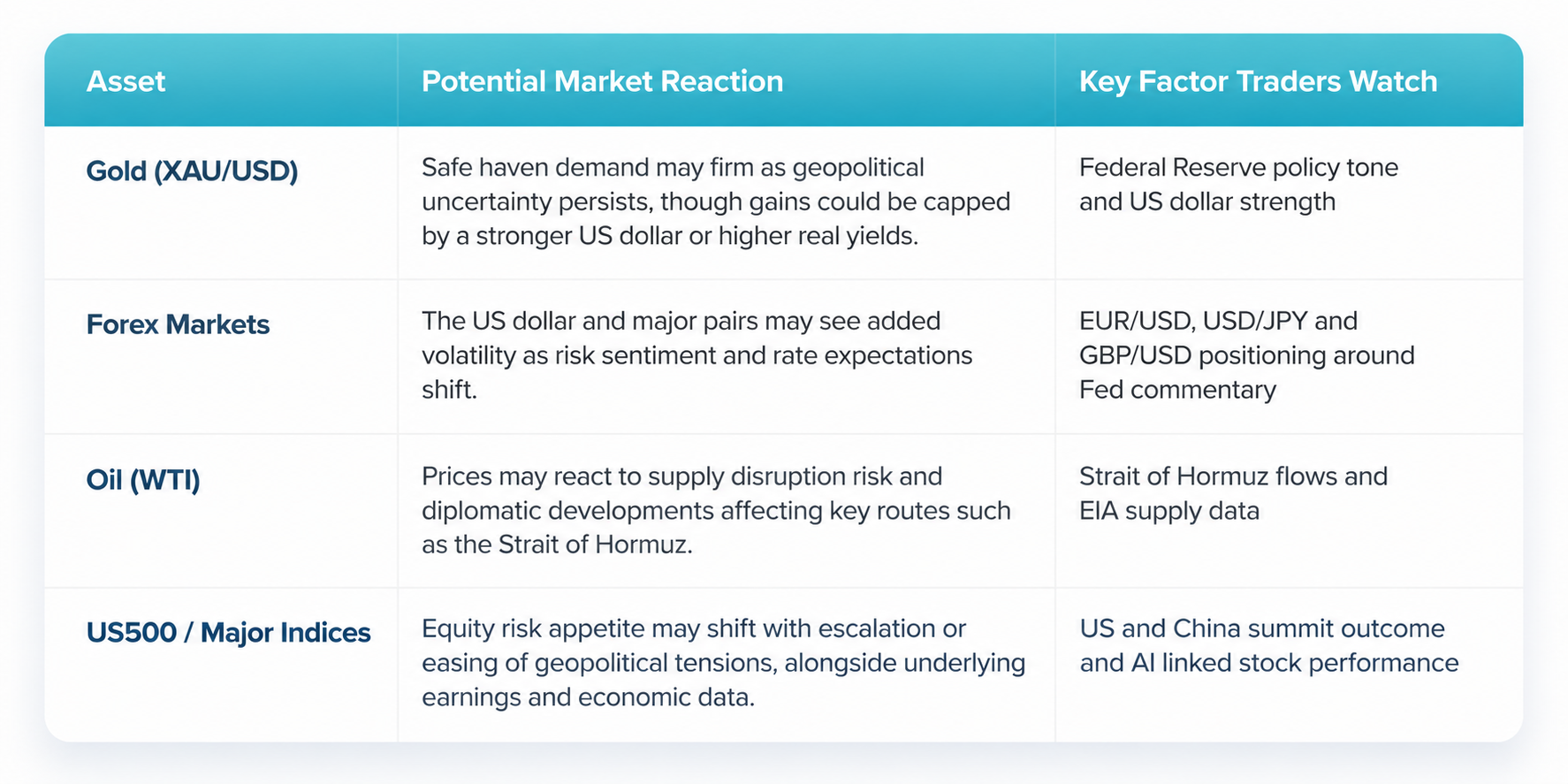
The table below sums up how today's developments could ripple across asset classes. It's a framework for analysis, not a price prediction: the actual market reaction depends on how each story develops from here.
Gold Market Outlook (XAU/USD)
Gold (XAU/USD) is trading near $4,346 an ounce. As one of the market's most established safe haven assets, gold tends to catch a bid when uncertainty rises, and this week that means the Moscow refinery strike and the still unresolved Iran diplomacy are both in the mix, alongside real yields and dollar strength. The tug of war for gold right now is safe haven demand pulling one way against a hawkish Federal Reserve pulling the other, since higher rates tend to cap gains in an asset that pays no yield.
Sources: World Gold Council: Gold Market Outlook
Forex Market Impact
Currency markets are usually first to move on geopolitical uncertainty, since they trade around the clock. The dollar has tended to firm during past bouts of uncertainty, supported by safe haven flows and shifting rate expectations. After the Fed's September 16 hike (25 basis points to a 3.75% to 4.00% range), the Dollar Index has held near levels not seen in months. Pairs most exposed to a pickup in volatility include:
· EUR/USD
· USD/JPY
· GBP/USD
Sources: Federal Reserve: September Rate Decision | CNBC: Fed Rate Decision Coverage
Oil Market Outlook (WTI)
WTI crude slipped to near $95.59 a barrel on September 21, down about 4.7% on the day. The EIA reports that Middle East oil production is recovering gradually as flows through the Strait of Hormuz and alternative routes pick up, though some export constraints are expected to linger into 2027. That gradual recovery sits alongside the Moscow refinery strike, which keeps disruption risk on the radar even though it hasn't yet shown up as a sustained move in benchmark pricing.
Sources: U.S. Energy Information Administration: Strait of Hormuz Oil Flows | Trading Economics: Crude Oil Price Data
Stock Market Reaction (US500)
Equities tend to track investor confidence and risk appetite closely. US benchmarks, including the US500, closed at or near record levels on September 21, helped along by AI linked names, a sign risk appetite has held up so far. That said, an escalation in any of today's stories, or a disappointing outcome from this week's US and China summit, could still introduce volatility into the sessions ahead.
Sources: Bloomberg: US Stock Market Update
What Could Move Markets Next
Beyond today's headlines, a handful of recurring catalysts tend to shape how markets behave in the days that follow a major geopolitical story. The Lirunex economic calendar is the quickest way to see what's scheduled next:
· Upcoming events: the Trump and Xi summit in Washington and a possible meeting between Trump and Pezeshkian at the UN General Assembly
· Economic data: preliminary PMI readings and other releases due this week
· Central bank guidance: further Federal Reserve commentary following the September hike
· Developing catalysts: confirmation of the Greenland deal signing, and any escalation in the conflict between Russia and Ukraine
Sources: CNBC: Trump-Xi Summit Preview | Bloomberg: US-China Trade Talks Report
Preparing To Trade Around Geopolitical Risk
Most traders pair geopolitical analysis with technical analysis rather than leaning on either alone. The news explains why a market might move; support and resistance levels help frame how far that move could extend. In practice, disciplined execution matters more than the headline itself: sizing positions sensibly, setting a stop loss before entering a trade, and testing an approach on a demo account before committing real capital are all part of trading around a week like this one.
Conclusion
Today's mix of an energy infrastructure strike, a new security pact and early stage diplomacy is a reminder of how closely geopolitical events and market impact stay linked across gold, forex, oil and equity indices. None of these stories has a predictable outcome, and this article isn't forecasting where any market goes next. It's mapping out what to watch and why. Staying informed, and pairing that awareness with sound technical analysis and risk management, tends to leave traders better positioned as the picture evolves.
Sources & References
Federal Reserve: September Rate Decision | CNBC: Fed Rate Decision Coverage | Bloomberg: Moscow Refinery Strike Report | The Moscow Times: Refinery Strike Report | NBC News: Greenland Security Deal Report | NPR: US-Denmark Greenland Agreement | CNBC: Iran-US Diplomacy Report | CNBC: Trump-Xi Summit Preview | Bloomberg: US-China Trade Talks Report | World Gold Council: Gold Market Outlook | U.S. Energy Information Administration: Strait of Hormuz Oil Flows | Trading Economics: Crude Oil Price Data | U.S. Energy Information Administration: Middle East Petroleum Markets | Bloomberg: US Stock Market Update
Following Global Markets With Lirunex
Track gold, oil, forex and indices alongside today's Moscow refinery strike, Greenland deal and Iran diplomacy on the Lirunex economic calendar, or explore how geopolitical events and market impact play out within a simulated environment via a demo account. Questions about how CFDs work? Our support team can help.
[ Open a Demo Account ] [ Lirunex Economic Calendar ] [ Contact Support ]
Risk Disclaimer: Forex and CFD trading involves significant risk of loss and may not be suitable for all investors. Past performance is not indicative of future results. Please ensure you fully understand the risks involved before trading.