










US Canada Tariff Dispute: What Happened?
The bilateral tariff dispute has hardened into a test of political will for both governments. US Treasury Secretary Scott Bessent downplayed Canada's position, calling the countries "not at war" and arguing the US economy is roughly thirteen times larger. In remarks reported August 31, he also mocked Canada's military capacity. Canadian Prime Minister Mark Carney rejected that framing. "You're at war when you get attacked. We got attacked," he said, after additional 50 percent US tariffs took effect August 22 on goods including wine, cement, dairy products and hockey equipment. He called the failed talks the result of "unfair, uneconomic" late demands from Washington.
Key facts:
● US tariffs: 50 percent took effect August 22 on select Canadian goods; energy is excluded.
● Canadian retaliation: 15, 25 and 50 percent tariffs on about C$27.6 billion of US imports, effective September 8.
● Energy carve-out: neither side's tariff list targets energy products.
● Key date: September 8 is the deadline if talks do not resume.
The escalation follows a broader pattern of US tariff actions through 2025 and 2026, marking a shift from decades of more predictable trade relations. The increasingly personal exchanges between officials have added political weight to the dispute in both capitals.
Market Impact: USD/CAD, Spot Gold, S&P 500 and WTI Crude
Given the scale of US-Canada trade, one of the largest bilateral relationships globally, the dispute carries direct implications across currency, commodity and equity markets:
● USD/CAD: the most directly exposed pair. Continued escalation could widen its trading range. A negotiated resolution could support the Canadian dollar instead. The Bank of Canada held its policy rate at 2.25 percent on September 2, and its inflation language raised expectations of future hikes.
● Gold (XAU/USD): can attract defensive demand during heightened political and trade uncertainty. Its reaction also depends on the US dollar, rate expectations and broader geopolitical developments.
● S&P 500 (US500): a more indirect channel. The tariffs target specific Canadian sectors, not the broader economy. Still, sustained escalation could raise inflation concerns that weigh on sentiment for companies with material Canadian exposure.
● WTI crude: relatively insulated, since energy is excluded from both tariff lists. Any expansion into energy or logistics would mark a material shift in risk for traders, given the depth of North American energy integration.
Businesses exposed to North American supply chains face a real repricing question. This includes agriculture, construction materials and consumer goods, where costs may be passed on to consumers. The episode also shows how political rhetoric can move markets before formal policy takes effect. Official statements are as important to track as the tariff schedule itself.
What Happens on September 8?
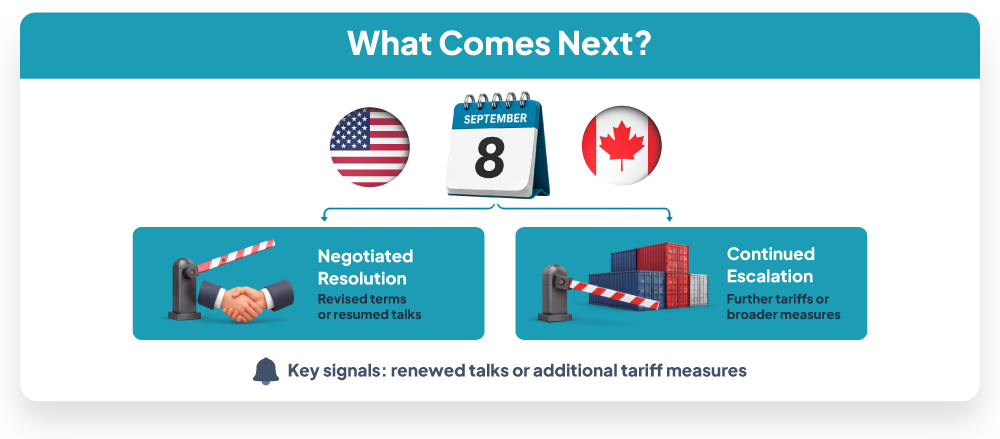
Canada's tariffs take effect September 8 unless the two sides reach a resolution. Headline volatility may increase around that date. Two scenarios are worth watching:
● Negotiated resolution: revised terms could support the Canadian dollar and ease near-term hedging demand for gold.
● Continued escalation: broader tariffs could sustain volatility and reinforce defensive positioning.
Domestic political pressure adds another variable. Carney faces scrutiny at home over the cost of retaliation to Canadian consumers and reliant industries. US officials face similar questions about tariffs and domestic prices ahead of the 2026 midterms. Either pressure point could accelerate a resolution on its own, regardless of the underlying trade positions. At this stage, both outcomes remain plausible, and neither government has confirmed a resumption of talks.
Sources: Canada counter tariffs | White House fact sheet | Reuters : tariffs | Reuters : talks | NY Post : Bessent | Reuters : BoC
When Politics Moves Markets
Political headlines, trade disputes and policy decisions can quickly reshape sentiment across currencies, metals, indices and oil. Stay informed with Lirunex’s economic calendar and market insights, explore live market pricing through a free demo account, or open a live account when you are ready to trade.
[ Open Free Demo Account ] [ Open Live Account ]
Risk Disclaimer: This article is for informational purposes only and does not constitute investment advice. Forex and CFD trading involves significant risk of loss. Past and demo results may differ from live trading.