











Anne Sinclair │ Financial Markets Content & Communications Strategist
Canada Jobs Data Explained | How Employment Change and Unemployment Rate Affect USD/CAD

Canada jobs data arrives once a month in Statistics Canada's Labour Force Survey, and it is one of the most closely watched releases for the Canadian dollar. This guide explains Employment Change and the Unemployment Rate, when they are released in GMT+8, and how USD/CAD and other CAD pairs may react.
If you trade USD/CAD, this is one report worth knowing well. It can produce sharp moves within seconds, and it sometimes lands at the same moment as major US data.
Canada Jobs Data: What It Is
Canada's main jobs report is the Labour Force Survey, or LFS, published by Statistics Canada. It is built from a monthly household survey that asks people about their work status during a reference week in the middle of the month. For August 2026, that week ran from 14 to 20 August.
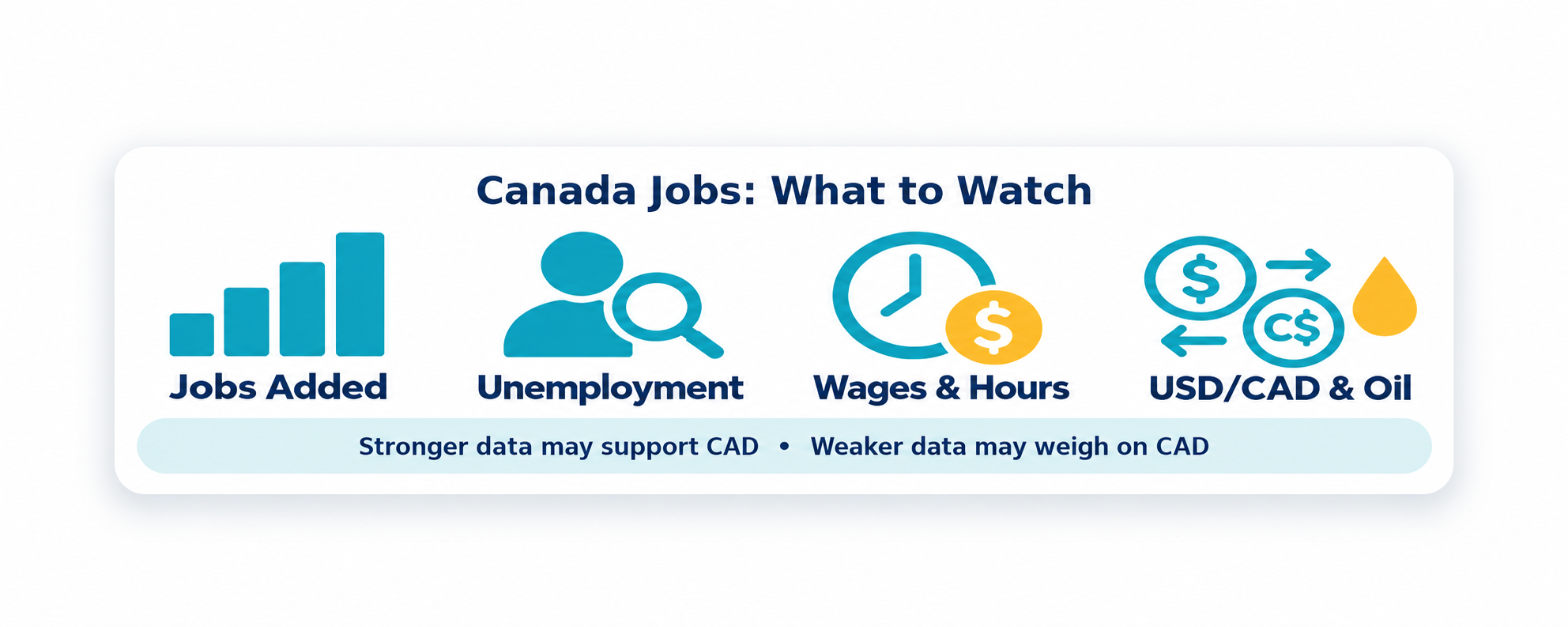
The report holds plenty of detail. Yet two headline figures drive most of the market reaction to Canada jobs data: Employment Change and the Unemployment Rate.
Employment Change
Employment Change is the net number of jobs added or lost over the month. A positive figure means more people were working than the month before. In August 2026, for example, employment fell by 41,700.
Analysts also look at the split between full time and part time work. A gain led by full time jobs is usually read as stronger than one led by part time roles.
Unemployment Rate
The Unemployment Rate is the share of the labour force that is out of work and actively looking for a job. It held at 6.4% in August 2026.
The labour force only counts people who are working or searching for work. If people stop searching, they leave the labour force, and the rate can fall even when jobs are lost.
Why the Two Figures Can Disagree
This is where beginners often get caught out. In June 2022, Canada's Unemployment Rate fell to 4.9% even though employment dropped by 43,200, because fewer people were taking part in the labour market. USD/CAD rose after that report, suggesting traders gave more weight to the job losses than to the lower rate.
So the first move is not always the final one. Many traders wait a few minutes to read the participation rate and wage growth before deciding what a set of Canada jobs data really says.
Sources: Nova ScotiaFinance: Labour Force Survey, August 2026| Nova ScotiaFinance: Labour Market Trends, August 2026| FXStreet:Canada Unemployment Rate, June 2022 Report
When Canada Jobs Data Is Released
Statistics Canada usually publishes the LFS on a Friday early in the month at 8:30am Eastern Time. In GMT+8 that is 8:30pm while Canada is on daylight saving time and 9:30pm during standard time.
The September 2026 report is due at 8:30pm GMT+8 on Friday 9 October 2026, and the October report follows at 9:30pm GMT+8 on 6 November. Our Week Ahead preview of Canada's jobs report and the FOMC minutes covers the October release in context.
Sources: Statistics Canada: 2026 Release Schedule | Saskatchewan Bureau of Statistics: Report Release Dates 2026 to 2027
How Canada Jobs Data Reaches the Canadian Dollar
The link runs through interest rates. Strong hiring and rising wages can add to inflation pressure, which may lead markets to expect a firmer Bank of Canada. That expectation could support the Canadian dollar. Weak hiring points the other way.
The Bank of Canada sets its policy rate on eight scheduled dates a year. It held the overnight rate at 2.25% on 2 September 2026, and its next decision is due on 28 October 2026. Each round of Canada jobs data released between decisions helps shape what markets expect from the next meeting.
Sources: Bank of Canada: Policy Rate Announcement, September 2026 | Bank of Canada: September 2026 Publications and Announcements | CREA: Bank of Canada Interest Rate Update, September 2026
The Oil Connection
Canada is a major oil exporter, so the Canadian dollar often moves with crude prices as well. On jobs day, a sharp swing in oil can blur the reaction to the data. Our note on why OPEC output decisions move oil prices explains why energy markets matter for CAD.
Markets That May React to Canada Jobs Data
The Canadian dollar takes the first hit, but the reaction can spread across several pairs. Here is where market participants usually look.

How Canada Jobs Data May Affect Forex
USD/CAD usually reacts first and most clearly. The pair shows how many Canadian dollars one US dollar buys, so a stronger Canadian dollar appears as USD/CAD falling. A strong report may push USD/CAD lower, while a weak one may lift it.
Cross pairs such as CAD/JPY and EUR/CAD may follow. CAD/JPY is useful to watch because it strips out the US dollar side of the move.
A real example helps. In October 2025, Canada reported 60,400 new jobs for September against a forecast of 2,800, and USD/CAD slipped after the release.
Sources: XTB: USD/CAD Reaction to Canada Employment Data, October 2025
When US and Canadian Data Land Together
Canada jobs data sometimes arrives at exactly the same moment as major US releases such as Nonfarm Payrolls. When that happens, USD/CAD reacts to both reports at once. Comparing the size of each surprise matters more than either number alone. Our earlier weekly review of USD/CAD and gold shows how the pair has traded around busy data days.
The US side has its own scheduled catalysts as well. Our companion guide on what FOMC meeting minutes reveal explains how Federal Reserve communication moves the dollar half of USD/CAD.
Trading Preparation Around Canada Jobs Data
A little preparation goes a long way on jobs day. These habits can help beginner traders stay calm when the numbers print.
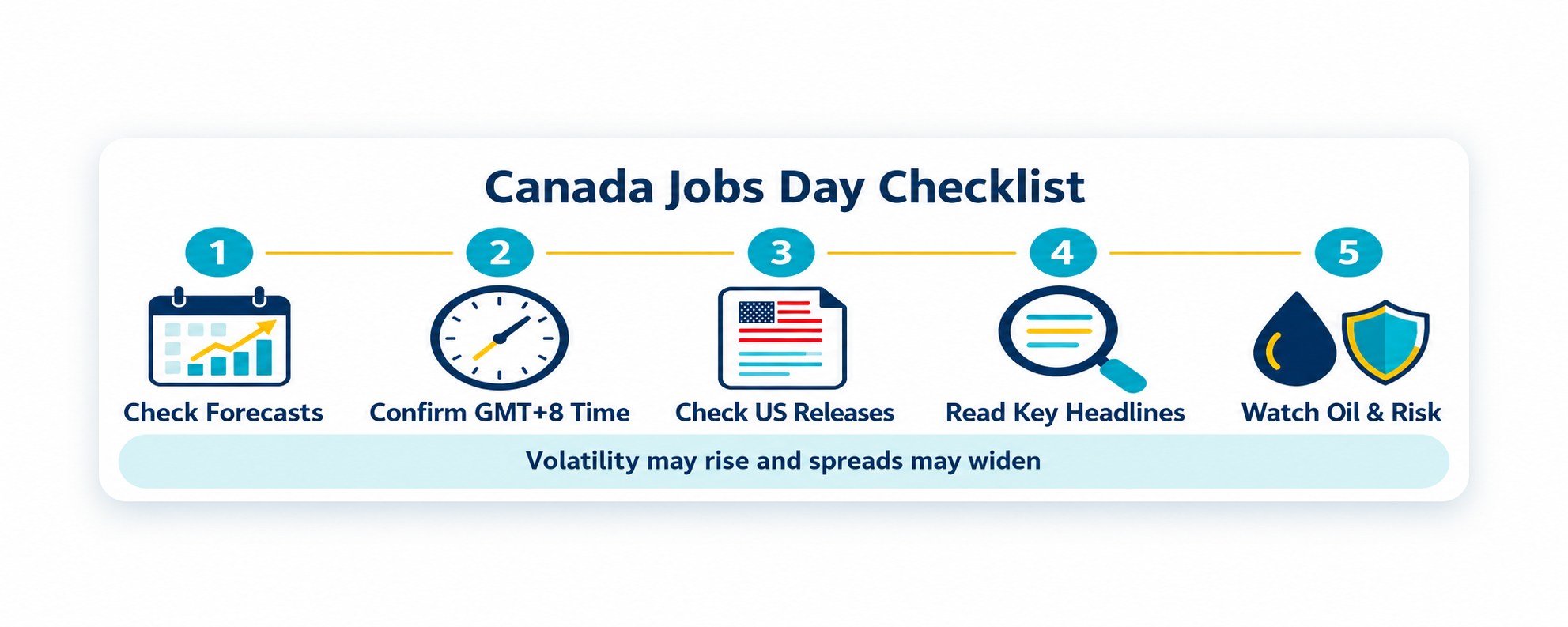
· Note the forecast and the previous reading for both Employment Change and the Unemployment Rate, so the size of any surprise is clear.
· Check the time in GMT+8 and whether US data is due at the same moment.
· Expect wider spreads. Market volatility may increase and spreads may widen briefly around the release.
· Read beyond the headline. Participation, full time versus part time jobs and wages can change the story within minutes.
· Keep an eye on oil, since crude can pull the Canadian dollar in a different direction.
· Plan risk before the release. Our overview of how scheduled economic news moves currencies covers this in more detail, and a demo account lets you practise in a simulated environment.
Key Takeaway
Canada jobs data is about more than one number. Employment Change and the Unemployment Rate arrive together, can point in different directions, and feed into what markets expect from the Bank of Canada. For beginner traders, reading both figures, plus the oil backdrop and any US data on the same day, gives a much clearer picture of what USD/CAD may do next.
Follow Lirunex for each Week Ahead preview so you always know when the next Canada jobs report is due.
Frequently Asked Questions
What is Canada jobs data?
Canada jobs data usually refers to Statistics Canada's monthly Labour Force Survey. Its two headline figures are Employment Change, the net number of jobs added or lost, and the Unemployment Rate.
What time is Canada jobs data released in GMT+8?
The report is released at 8:30am Eastern Time, which is 8:30pm GMT+8 during Canadian daylight saving time and 9:30pm GMT+8 during standard time. The September 2026 report is due on 9 October 2026 at 8:30pm GMT+8.
Why can the Unemployment Rate fall when jobs are lost?
The rate only counts people in the labour force. If people stop looking for work, they leave the labour force, so the rate can drop even while employment falls.
Which currency pairs react to Canada jobs data?
USD/CAD usually reacts first. CAD/JPY, EUR/CAD and AUD/CAD can also move, especially when the report is far from forecast.
How does Canada jobs data affect Bank of Canada decisions?
Employment and wage growth feed into inflation, which guides the Bank of Canada's interest rate decisions. A run of strong or weak reports can shift expectations for its next meeting.
Why does oil matter for the Canadian dollar?
Canada is a major oil exporter, so crude prices can influence the Canadian dollar. A large move in oil on jobs day can strengthen or offset the reaction to the data.
Sources and References
Sources: Statistics Canada: 2026 Release Schedule | Saskatchewan Bureau of Statistics: Report Release Dates 2026 to 2027 | Nova Scotia Finance: Labour Force Survey, August 2026 | Nova Scotia Finance: Labour Market Trends, August 2026 | Bank of Canada: Policy Rate Announcement, September 2026 | Bank of Canada: September 2026 Publications and Announcements | CREA: Bank of Canada Interest Rate Update, September 2026 | FXStreet: Canada Unemployment Rate, June 2022 Report | XTB: USD/CAD Reaction to Canada Employment Data, October 2025
Ready for the Market's Next Move?
Follow the key economic events ahead and practise observing how markets react around major releases with a free Lirunex demo account, within a simulated environment. Open a live account once you feel ready and understand the risks involved. Demo conditions and results may differ from live trading.
[ Open Free Demo Account ] [ Open Live Account ]
Risk Disclaimer: This article is for informational purposes only and is not investment advice. Demo results may differ from live trading. Forex and CFD trading involve significant risk of loss. Past performance is not indicative of future results. High impact events may cause sharp volatility, wider spreads and sudden price movements. Please understand the risks before trading.