










What Is Forex Trading and How Does It Work? A Beginner’s Guide
Forex trading, short for foreign exchange trading, is the buying and selling of currencies to benefit from changes in exchange rates. It is the largest and most liquid financial market in the world, with global daily turnover of USD 9.6 trillion in April 2025, according to the Bank for International Settlements. If you have ever exchanged money before travelling abroad, you have already taken part in this market.
What Is Forex Trading?
Forex trading involves exchanging one currency for another through currency pairs such as EUR/USD or GBP/USD. The first currency in the pair is the base currency and the second is the quote currency. The price shows how much of the quote currency buys one unit of the base currency. If EUR/USD trades at 1.1000, one euro is worth 1.10 US dollars.
Unlike the stock market, forex has no central marketplace. Instead, trading happens over the counter through a global network of banks, institutions, and online brokers, running 24 hours a day, five days a week, across sessions in Sydney, Tokyo, London, and New York.
How Does Forex Trading Work?
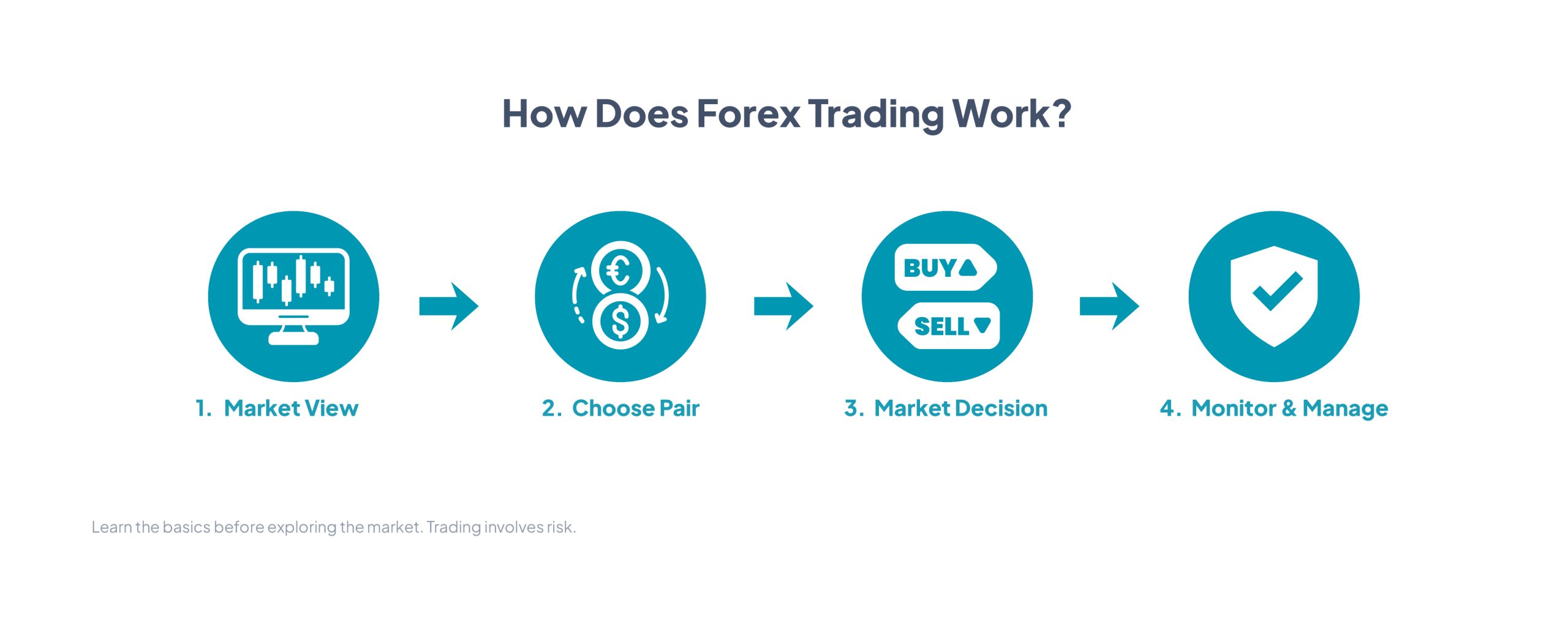
Forex trading involves speculating on whether one currency will strengthen or weaken against another. The process generally follows four steps:
1. Market View: Review market conditions, price movements, and relevant economic news.
2. Choose a Currency Pair: Select the currency pair you want to observe, such as EUR/USD.
3. Make a Market Decision: Decide whether to buy if you expect the first currency to strengthen, or sell if you expect it to weaken.
4. Monitor and Manage: Track the position and manage your risk using tools such as stop-loss and take-profit orders.
What Moves the Forex Market?
Currency prices do not move at random. Exchange rates respond to interest rate decisions, inflation data, employment figures, geopolitical events, and market sentiment. Because central bank announcements often trigger sharp moves, many traders follow an economic calendar.
How to Start Forex Trading as a Beginner
Once you understand these basics, build a simple trading plan and test it on a demo account first. When you are ready, choose a regulated online broker, begin with small positions, and always use risk management tools such as stop-loss orders. Never trade with money you cannot afford to lose.
FAQ: Common Questions from New Traders
How much money do I need to start forex trading?
There is no fixed amount. Many brokers offer low minimum deposits and micro lots. Start small and only trade with money you can afford to lose.
Is forex trading legal and safe?
Forex trading is legal in most countries. Choose a regulated broker that segregates client funds, and remember that trading always carries market risk.
Can beginners make money from forex trading?
There are no guaranteed profits, and many beginners lose money while learning. Treat trading as a skill that takes education and risk management, not quick income.
Which currency pairs are best for beginners?
Major pairs such as EUR/USD, GBP/USD, and USD/JPY are popular with new traders thanks to high liquidity, tighter spreads, and abundant market analysis.
What is the best time to trade forex?
Liquidity peaks during the London and New York session overlap, when trading activity is highest and spreads are usually at their tightest.
Do I need to practise before trading real money?
Yes. A free demo account lets you trade virtual funds in live market conditions and test your strategy without financial risk.
Start Your Forex Journey with Confidence
Understanding how the forex market works is the first step toward trading with confidence. Build your knowledge, practise on a demo account, and go live only when you feel ready. With a regulated broker like Lirunex, you get transparent pricing, educational resources, and dedicated support as you learn.
Ready to Take Your First Step?
Open a free Lirunex demo account today, practise in real market conditions, and switch to a live account when you are ready.
[ Open Free Demo Account ] [ Open Live Account ]
Risk Disclaimer: Forex and CFD trading involves significant risk of loss and may not be suitable for all investors. Past performance is not indicative of future results. Please ensure you fully understand the risks involved before trading.