













MAM Plus Account Explained: How It Compares With MAM and PAMM at Lirunex
A MAM Plus account lets you follow a professional trader's strategy while your money stays in your own sub account, measured in US cents rather than dollars. It is one of three managed account options at Lirunex, alongside MAM and PAMM. Each one handles investor funds differently, so the choice affects trade size, withdrawals and fees. This guide explains how each works and what to check before you subscribe.
What Is a MAM Plus Account?
A MAM Plus account is a managed account in which a master trader runs one strategy from a USD master account. Meanwhile, each investor holds a separate cent sub account. When the master opens a position, the platform places a proportional trade in every linked sub account. As a result, your balance, your trades and your profit or loss stay visible in your own account. Think of it as copying with your own ledger. You share the strategy, but the records are yours.
How the MAM Plus Account Uses Cent Sub Accounts
In a MAM Plus account, investor funds sit in USC sub accounts, where USC means US cents. For example, a deposit of USD 500 appears as 50,000 USC. The money is the same; only the unit changes. Because the system sizes positions against a cent balance, smaller balances can follow the master's trades in proportion.
Approvals, Top Ups and Payouts
Each master decides how the MAM Plus account handles money movements. The system can approve subscriptions, top ups and withdrawals automatically, or the master can approve them manually. Fee payouts can also follow a daily, weekly or monthly cycle. Therefore, read the strategy's settings before you fund a MAM Plus account, since they decide how quickly you can add or remove money.
How Standard MAM Works
A standard MAM account, short for Multi Account Manager, works in a similar way, although everything stays in US dollars. The system allocates each trade across linked investor accounts using the master's lot allocation method. Your funds stay in your own account, and you join only future trades. Compared with a MAM Plus account, the main difference is the dollar unit and therefore the smallest possible trade size.
How a PAMM Account Works
PAMM stands for Percentage Allocation Management Module. Here, all investor money sits in one shared account. The manager trades once, and each investor's share of the pool sets their result. For example, an investor who supplies 20% of the pool receives 20% of the profit or loss. PAMM is the simplest structure to set up. However, other investors' deposits and withdrawals also change the pool. You also see your share of the pool rather than individual trades in your own name.
MAM Plus Account vs MAM vs PAMM: Key Differences
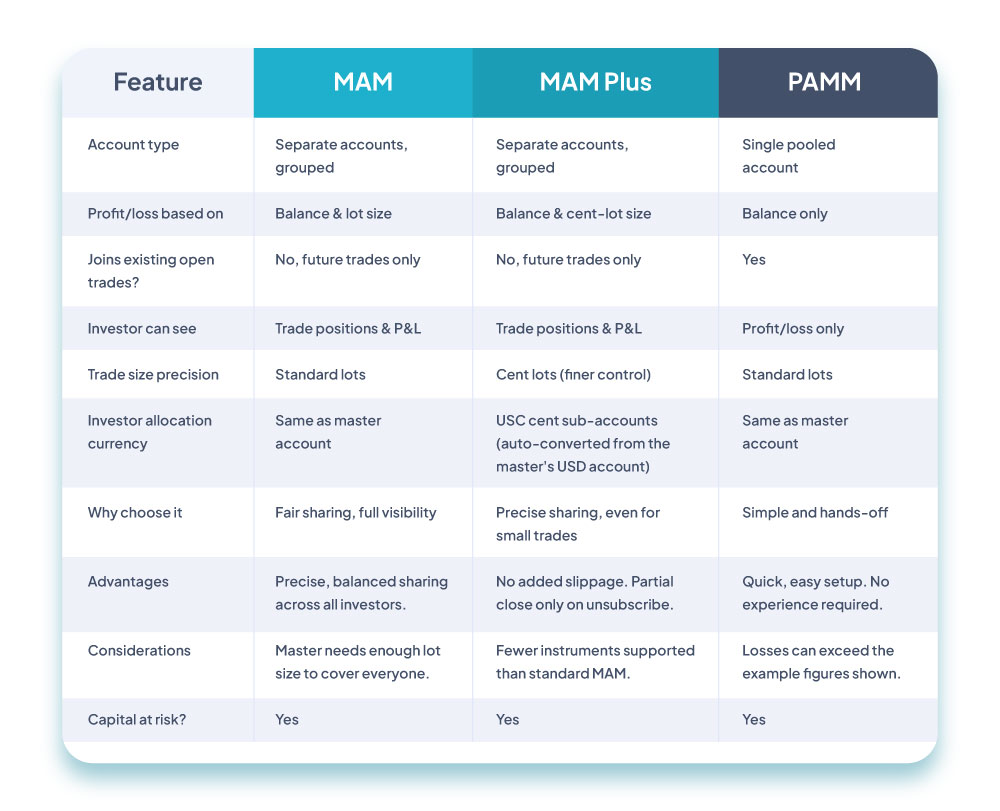
How MAM, MAM Plus and PAMM Handle Trades, Money and FeesTap to open / Tap to close ▾
| Feature | MAM | MAM Plus | PAMM |
|---|---|---|---|
| How trades reach you | Allocated by the master's lot allocation method | A proportional trade in each cent sub account | One trade, with the result split by share |
| Deposits and withdrawals | Set by the master | Automatic or manual approval, set by the master | Set by the master; other investors' movements also change the pool |
| Fees | Set by the master, often a performance fee | Set by the master, often a performance fee | Set by the master, often a performance fee |
| Typical use | Investors who want their own USD account | Smaller balances following a strategy in proportion | Investors who prefer a simple pooled share |
Fees, approvals and payout schedules vary by master. Check each strategy's terms before you subscribe.
In short, a MAM Plus account keeps your money separate like MAM, but it measures it in cents. PAMM, by contrast, trades a single pool. Our longer PAMM and MAM accounts guide also covers the fund manager side.
Costs and Risks to Check Before You Subscribe
Every MAM Plus account carries the master's fees on top of normal spreads or commissions. A performance fee is common. It may use a high water mark, so the fee applies only to new profits above the previous peak. For example, an account peaks at USD 1,200, falls to USD 1,000 and then recovers to USD 1,300. The fee then applies only to the USD 100 above the old peak. Because terms vary by master, compare each strategy on the Lirunex MAM page before you commit.
Risk deserves the same attention. Forex and CFDs use leverage, so you could lose part or all of your capital. Losses also follow the same split as profits, and past results never guarantee future performance. In addition, complaints about managed account trading fall outside the Compensation Fund described in our Financial Commission membership guide.
Above all, the master's skill drives your result, so check these points before you open a MAM Plus account:
- How long the master has run the strategy with real money.
- The largest fall from a previous peak, known as drawdown.
- The fee type, the rate and the payout schedule.
- Whether withdrawals need the master's approval.
MAM Plus, MAM or PAMM: Which Fits You?
There is no single best choice, so match the structure to how you want to hold your money:
- A MAM Plus account suits smaller balances that want each trade visible in their own cent sub account.
- MAM suits investors who want their own USD account and standard lot sizes.
- PAMM suits investors who prefer a simple pooled share and a hands off setup.
On the other hand, investors who want more control can look at copy trading for followers and providers, where you choose the provider and adjust settings yourself.
MAM Plus Account FAQ
What Is the Difference Between MAM and PAMM Accounts?

A MAM account keeps each investor in a separate account, and the system allocates the master's trades to each one. A PAMM account pools all investor money, so you see your profit or loss rather than individual trades. A MAM Plus account works like MAM, but in US cents.
Are MAM and PAMM Accounts Safe?
No managed account is free of risk. MAM, MAM Plus and PAMM accounts all trade leveraged products, so your capital is at risk. A separate sub account adds transparency, but it does not protect you from market losses.
How Do I Withdraw From a MAM Plus Account?
That depends on how the master set up the MAM Plus account. Some withdrawals go through automatically, while others need the master's approval, so check the strategy terms. You then manage your funds in the Lirunex client portal.
Do I Need Trading Experience to Use a MAM or PAMM Account?
No. You need no trading experience to open a MAM Plus account, because the master makes the trading decisions. Still, you should understand the fees and risks before you commit any money.
Can I Join a Trade That Is Already Open?
In MAM and MAM Plus accounts, you join only future trades, not positions already open. In a PAMM account, however, your money joins the pool, so you share in trades that are already open.
Sources3Research and data references for this section · tap to view▾
Last updated 24 November 2026. Originally published 31 July 2026. Product details from the Lirunex MAM, MAM Plus and PAMM materials; terms vary by master.
Explore Managed Accounts With Lirunex
Want to see how a MAM Plus account could fit your goals? Explore our platforms and support with a free demo account that uses virtual funds, then open a live account when you feel ready and understand the risks involved. Demo conditions and results may differ from live trading.
Open Free Demo Account | Open Live Account
Risk Disclaimer: This article is for informational purposes only and is not investment advice. Managed account results depend on the master's strategy, and past performance does not guarantee future results. Forex and CFD trading involve significant risk of loss, and demo results may differ from live trading. Please review Lirunex's Regulations and Licenses and ensure that you understand the risks before trading.