





Anne Sinclair | Financial Markets Content & Communications Strategist
Toxic Flow in Forex Trading: Why Not All Volume Is Good
Toxic flow in forex trading describes order activity that may create outsized execution risk for a broker or liquidity provider, because it repeatedly takes advantage of pricing delays, stale quotes or other short lived market conditions. The phrase can sound accusatory, so it needs careful handling. Profitable, frequent or automated trading is not automatically improper.
This guide explains the difference in plain language, why trading volume alone can mislead, and how brokers may review order flow fairly. It draws on Episode 15 of the Your Bourse Podcast, where Lirunex CEO Jack Foong discussed why a broker may look beyond headline volume. His comments are paraphrased as industry perspective, not as a rule for every broker.
Toxic Flow in Forex Trading: What It Means
In practical terms, toxic flow in forex trading is a risk label used by brokers and liquidity providers, not a universal legal definition. Liquidity providers are the banks and trading firms that supply the prices a broker shows to its clients. The label is often applied to order flow that repeatedly arrives just before the price moves against the firm filling the order.
Examples may include strategies that act on a faster price feed while a broker is still displaying an older quote. Because firms use different technology and hedging arrangements, the same order flow may suit one broker and not another, so the label cannot be applied from a strategy name alone.
Key Terms Behind Toxic Flow
How Latency Arbitrage Relates to Toxic Flow
Latency arbitrage is capturing a price difference simply by being faster than other participants. The Bank for International Settlements has described such opportunities as primarily a contest in speed, although its research studied stock exchanges rather than forex.
In forex, the Global Foreign Exchange Committee describes last look as a final check that lets a liquidity provider accept or reject a trade request against its quoted price, and it treats the check as a risk control. Neither source says that every fast trader creates toxic trading flow.
Sources2Sources for toxic flow in forex trading · tap to view
Why Toxic Flow in Forex Trading Depends on the Broker Model
A broker may keep some risk on its own book, hedge individual trades or pass exposure to outside providers. Each model reacts differently to fast or concentrated order flow, which is why the label is best described as a question of execution impact, not a judgement about how much a client trades.
Why High Forex Trading Volume Can Be Misleading
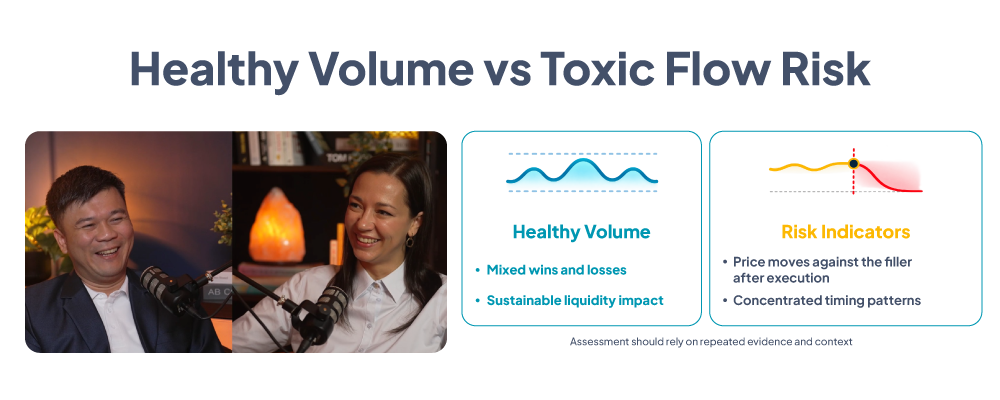
Volume is a headline number that can hide a lot. An account may produce thousands of lots while creating repeated slippage or hedging problems, which is how toxic flow can hide inside a large volume figure.
In the podcast, Jack framed this as a long-term business decision. A broker that accepts every source of volume may enjoy a short burst of activity but inherit extra liquidity costs and client disputes. Explainable execution and a sound reputation can matter more than one strong month, and toxic order flow is volume that looks attractive on a dashboard but may cost more than it earns.
Sources1Sources for toxic flow in forex trading · tap to view
Legitimate Trading Is Not Automatically Toxic Flow in Forex Trading
Careful review separates strategy type from execution evidence. Scalping, expert advisers, copy trading and active intraday trading can all be legitimate when they follow the account terms. Labelling activity as toxic flow solely because it is profitable or fast may be unfair, and a finding of toxic trading flow should rest on a repeated, documented pattern.
If these terms are new, start with the basics. Our guides to how forex trading works and major forex pairs explain orders, spreads and currency pairs. Traders using automation may compare AI trading bots with manual trading before choosing a method.
How Brokers May Review Toxic Flow in Forex Trading
A responsible review is usually based on evidence and kept proportionate. In the podcast, Jack described steps such as asking prospective partners for a trading track record, involving the dealing team and consulting liquidity providers before accepting material order flow. The aim is to set expectations early, not to accuse anyone after losses.

Review the Available Track Record
Historical activity may show trade duration, instruments, trading times and order frequency. No single measure proves a problem, and a pattern matters more when several indicators agree across a meaningful sample.
Compare the Strategy With the Execution Model
A broker may check whether it keeps risk in house, hedges each trade or routes exposure to outside providers, and whether the platform suits the strategy. Traders comparing technology can read our MT4, MT5 and WebTrader platform comparison. Confirm execution expectations before funding, not afterwards.
Markout Analysis for Toxic Flow in Forex Trading
Markout analysis measures how the market price changes after an order is filled, at several short time intervals. If prices repeatedly move against the filling firm right after certain orders, the pattern may point to adverse selection, which means the firm is often on the wrong side just after a fill. The test is more useful across a series of trades than on one transaction. Your Bourse, a risk and reporting provider, lists a Markouts Report in its release notes.
Sources1Sources for toxic flow in forex trading · tap to view
Monitor Live Behaviour and Investigate Exceptions
Brokers may use live monitoring and exception reports to spot unusual concentrations in order flow or sudden changes in behaviour. Alerts show what deserves attention, but a person should review the context before any decision.
Toxic Flow in Forex Trading: Communication Before Enforcement
Clear communication is a strong control. Brokers should explain prohibited practices, execution rules and review procedures in plain language, including how toxic flow is defined. Introducing partners should describe the expected client base accurately.
A fair response to suspected toxic flow usually starts with a defined review period, not an instant conclusion. The reviewer can compare the account with market data, confirm the timing of each order and check whether similar outcomes repeated, while telling the client which account term is relevant. If a liquidity provider raised a concern, the broker should still run its own assessment.
Proportion matters too. A few unusual fills during exceptional volatility may justify monitoring without proving a persistent strategy. Any restriction should follow the agreement, applicable regulation and a consistent internal process.
What Traders Should Understand
A forex demo account can help a new trader learn the platform and practise order entry without committing live capital. It cannot match every live market condition, but it may reveal operational mistakes early.
Key Takeaway
Toxic flow in forex trading should be judged by documented behaviour, execution evidence and the broker's own risk model. High volume is not automatically high quality business, toxic order flow can cost more than it earns, and profitable, automated or frequent trading is not automatically abusive. Early disclosure may reduce disputes.
Follow Lirunex for more beginner friendly guides on how brokers, platforms and execution work, so you know what to ask before you trade.
Frequently Asked Questions
What does toxic flow in forex trading mean?
It usually refers to order behaviour that repeatedly creates adverse execution or hedging outcomes for a broker or liquidity provider, often by exploiting short lived pricing differences. The term is operational, and different firms may define it differently.
Is scalping considered toxic trading flow?
Not automatically. Scalping may be permitted when it follows the account terms, and a broker should look at the actual timing, pricing and execution evidence rather than the strategy label.
What is latency arbitrage?
It generally means acting on faster market information while another venue is still showing a price that has not updated.
How does markout analysis help a broker?
Markout analysis compares the execution price with later market prices at selected intervals. Repeated adverse movement after a type of order flow may support further review, but isolated outcomes do not establish a pattern.
Can a broker reject toxic order flow?
A broker may restrict activity that falls outside its terms or risk appetite, subject to the account agreement and applicable rules. Clear disclosure, consistent treatment and documented evidence matter.
Is high trading volume always good for a broker?
Not necessarily. Volume is most useful when it comes with sound execution and a broker that can manage the resulting exposure, and toxic flow can make a high volume month expensive.
Sources and References
Sources9Sources for toxic flow in forex trading · tap to view
Learn, Practise and Choose Your Account Carefully
Explore Lirunex education resources and practise with a free demo account, within a simulated environment. Open a live account once you feel ready and understand the risks involved. Demo conditions and results may differ from live trading.
[ Open Free Demo Account ] [ Open Live Account ]
Risk Disclaimer: This article is for informational purposes only and is not investment advice. Demo results may differ from live trading. Forex and CFD trading involve significant risk of loss, and leverage can magnify both gains and losses. Past performance is not indicative of future results. Order execution, slippage and spreads may differ between demo and live conditions. Consider your objectives, experience and risk tolerance, and seek independent advice where appropriate. Please understand the risks before trading.