














US NFP and Australia GDP: Week Ahead Market Outlook, Nov 30 to Dec 4, 2026
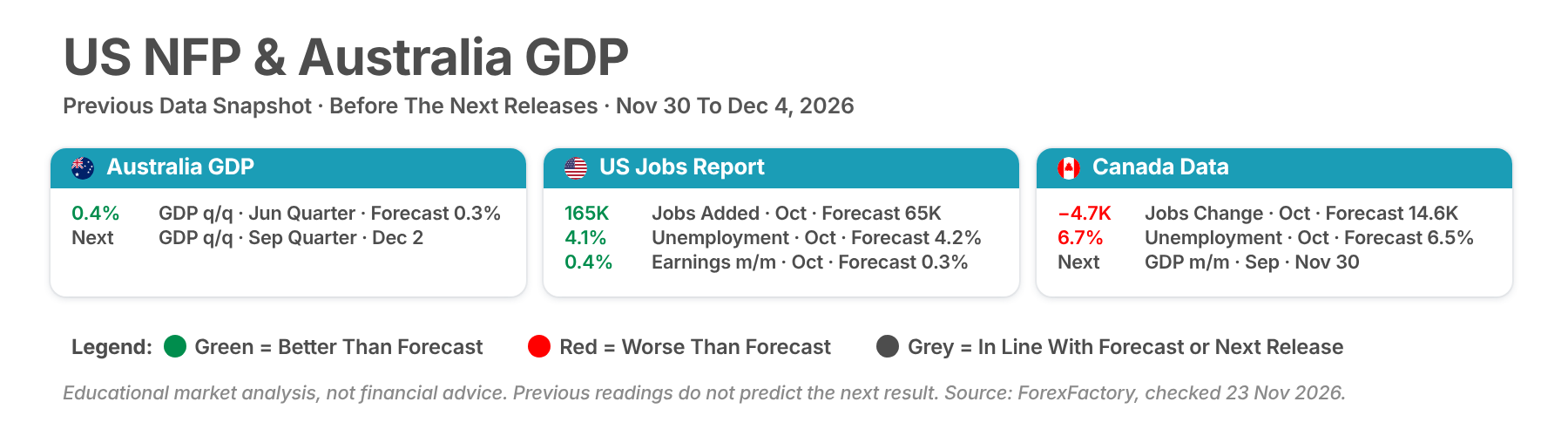
This weekly economic news update covers US NFP and Australia GDP, the two headline releases of 30 November to 4 December 2026, alongside Canada GDP and jobs. Australia GDP lands on Wednesday 2 December, while the US jobs report follows on Friday 4 December at 1:30pm UTC. Previously, we covered the Week Ahead on Australia CPI and core PCE. All times are UTC.
US NFP and Australia GDP: Weekly Market Overview
The US NFP and Australia GDP releases sit in a week with ten high impact events, including speeches by the Bank of Japan and RBA governors, and both arrive during a tightening cycle. The RBA raised its cash rate to 4.85% on 3 November, the Bank of Canada (BoC) lifted its rate to 2.50% on 28 October, while the Federal Reserve held at 3.75% to 4.00%.
Because the table below shows the schedule on the economic calendar, it is the quickest guide to the week. Consensus forecasts were still not available when the data was rechecked on 27 November 2026, so they are marked Not available. However, this weekly market outlook does not predict the outcome of US NFP and Australia GDP.
Week at a Glance
Main Analysis
Canada GDP: Monday 30 November, 1:30pm UTC
Monday 30 November
High Impact Economic Events · All Times UTC
1:05am UTC
JPY

BOJ Gov Ueda Speaks
View more ▾
BOJ Gov Ueda Speaks
Why It Matters
Because Governor Ueda sets the tone for Bank of Japan policy, his remarks can shift rate expectations.
Possible Market Impact
Hints about the next rate move may move USD/JPY and AUD/JPY, so yen pairs may react first.
1:30pm UTC
CAD

GDP m/m
View more ▾
GDP m/m
Why It Matters
Because GDP m/m measures the monthly change in output, it is a quick read on momentum.
Possible Market Impact
A result far from expectations may move USD/CAD, so BoC rate views may shift.
Before that, Bank of Japan Governor Ueda speaks at 1:05am UTC, so USD/JPY may move early in the Asian session. Then Statistics Canada publishes GDP m/m at 1:30pm UTC on Monday 30 November.
August GDP was flat at 0.0%, while the advance estimate for September was a 0.1% fall, so traders may compare the result with that estimate. Because the BoC decides next on 9 December, growth data may shape views on more tightening, while USD/CAD may react first.
RBA Governor Bullock Speech: Tuesday 1 December, 8:15am UTC
Tuesday 1 December
High Impact Economic Events · All Times UTC
8:15am UTC
AUD

RBA Gov Bullock Speaks
View more ▾
RBA Gov Bullock Speaks
Why It Matters
Because Governor Bullock leads the RBA, her comments can signal whether the 4.85% cash rate goes higher.
Possible Market Impact
A firmer tone may lift AUD/USD and AUD/JPY, while a softer tone may weigh on the Australian dollar.
RBA Governor Michele Bullock speaks at 8:15am UTC on Tuesday 1 December, one day before Australia GDP. Because October CPI rose 4.9% y/y after the November hike, traders may listen for any hint about a further move on 8 December.
A firmer tone may support AUD/USD, while a cautious tone may weigh on it. However, a speech is not a data release, so any reaction may be short lived.
Australia GDP: Wednesday 2 December, 12:30am UTC
Wednesday 2 December
High Impact Economic Events · All Times UTC
12:30am UTC
AUD
GDP q/q
View more ▾
GDP q/q
Why It Matters
Because it is the broadest gauge of the economy, GDP q/q matters for the RBA.
Possible Market Impact
Because growth drives the AUD, a surprise may move AUD/USD and AUD/JPY.
7:30am UTC
CHF

CPI m/m
View more ▾
CPI m/m
Why It Matters
Swiss CPI m/m guides inflation views because it tracks monthly price changes.
Possible Market Impact
A surprise may also move USD/CHF and EUR/CHF.
The Australian Bureau of Statistics (ABS) publishes GDP q/q for the September quarter at 12:30am UTC on Wednesday 2 December, the broadest gauge of the Australian economy.
Previously, June quarter GDP grew 0.4% q/q and 2.1% over the year. Since no consensus was available, a result above 0.4% may be read as resilient growth, while a weaker one could support the view that the economy is slowing.
Before this release, the RBA raised its cash rate on 3 November in a 6 to 3 vote and said inflation should stay above 3%. So stronger growth may support more tightening, while weak growth could favour the three members who preferred to hold. Our weekly analysis of the RBA rate decision and nonfarm payrolls shows how RBA expectations feed into AUD moves, and AUD/USD and AUD/JPY may be most active in the Asian morning.
US NFP and Canada Jobs: Friday 4 December, 1:30pm UTC
Friday 4 December
High Impact Economic Events · All Times UTC
1:30pm UTC
CAD
Employment Change & Unemployment Rate
View more ▾
Employment Change & Unemployment Rate
Why It Matters
Because it shows how the labour market is holding up, it guides BoC rate views.
Possible Market Impact
Results far from expectations may also move USD/CAD, especially as US jobs data lands at the same minute.
1:30pm UTC
USD

Non Farm Employment Change, Unemployment Rate & Average Hourly Earnings m/m
View more ▾
Non Farm Employment Change, Unemployment Rate & Average Hourly Earnings m/m
Why It Matters
Because it shows hiring and wage growth, it shapes Fed rate views.
Possible Market Impact
Surprises may also move the US dollar, gold and US indices.
The US Bureau of Labor Statistics (BLS) publishes the November Employment Situation at 1:30pm UTC (8:30am in New York). The headline is Non Farm Employment Change, the jobs added outside farming, although the report also includes the Unemployment Rate and Average Hourly Earnings m/m. Meanwhile, Statistics Canada releases its jobs data at the same minute.
Previously, the October report showed 165,000 jobs added, unemployment of 4.1% and hourly earnings up 0.4% m/m. This week raised the stakes: core PCE inflation rose to 3.3% y/y in October and third quarter GDP grew 4.3% against a 3.5% forecast, so Friday's report is the last jobs reading before the Fed meets on 9 December. Since no consensus was available, stronger hiring and wages could support firmer rate views, while weaker figures may raise talk of a slowdown.
Canada Jobs and USD/CAD
Meanwhile, Canada lost 4,700 jobs in October and unemployment rose to 6.7%. Our guide to Canada jobs data and USD/CAD explains both figures, and another soft report could raise questions about the BoC's 9 December decision.
Since both jobs reports land together, USD/CAD may see opposing forces, and market volatility may be highest in the first minutes after the release.
Sources6Research and data references for this section · tap to view▾
Markets That May React to US NFP and Australia GDP
These are the four markets most linked to this week's releases, because they may react first; this is educational context, not advice.
How US NFP and Australia GDP May Affect Forex
▼
The Australian dollar is exposed first, because AUD/USD is tied to RBA rate expectations while AUD/JPY is more sensitive to growth and risk appetite. Meanwhile, USD/CAD may be pulled by Canada GDP on Monday and two jobs reports on Friday.
How US NFP May Move Gold and Indices
▼
Gold tends to respond to US rate expectations, so softer jobs data may lift XAU/USD, while stronger data may pressure it. Likewise, US indices may react to the same figures.
Sources1Research and data references for this section · tap to view▾
Risks to Watch and Key Takeaway
- RBA tone before Australia GDP: Governor Bullock speaks on Tuesday, one day before the GDP print, so a firm or cautious message may set the direction of AUD/USD before the data lands.
- The Canada and US jobs split: both reports arrive at 1:30pm UTC on Friday, so a strong US print against a weak Canadian one, or the reverse, could add market volatility to USD/CAD.
- No consensus yet: forecasts for Australia GDP and Swiss CPI were still unpublished on 27 November, so previous readings are the reference points until ForexFactory posts them.
Overall, this weekly economic news update on US NFP and Australia GDP turns on Wednesday's growth figure and Friday's jobs reports. These are conditional scenarios, not forecasts, so beginners may find it easier to watch how price settles than to chase the first move. Follow Lirunex for each weekly economic news update.
Frequently Asked Questions
What is NFP and why does it matter?▼
Because NFP, or Non Farm Payrolls, counts the jobs added outside farming, it influences Fed rate expectations, so it may move the dollar, gold and US indices.
When is Australia GDP released?▼
The ABS releases GDP q/q for the September quarter on Wednesday 2 December at 12:30am UTC, so it lands early in the Asian session.
Why do Canada jobs and US NFP arrive together?▼
Both are released on Friday 4 December at 1:30pm UTC, so USD/CAD may see two sets of data at once, and because of that spreads (the gap between the buy and sell price) may widen.
What should traders monitor before major economic releases?▼
Before US NFP and Australia GDP, traders using forex market news may check the economic calendar for the release time, note the previous reading and allow for market volatility. Reviewing position sizing (how much of an account is risked on one trade) beforehand is more practical than adjusting mid move; Lirunex trading calculator can help you plan trade size, and our how economic news affects forex explains why these releases move currency pairs.
Sources and References
Sources10Research and data references for this section · tap to view▾
Ready for the Market's Next Move?
Discover the key economic events ahead and practice observing how markets react around important news releases with a free Lirunex demo account. Open a live account to experience real market conditions once you feel ready and understand the risks involved. Demo conditions and results may differ from live trading.
Open Free Demo Account | Open Live Account
Risk Disclaimer: This article is for informational purposes only and is not investment advice. Demo results may differ from live trading. Forex and CFD trading involve significant risk of loss. Past performance is not indicative of future results. High impact events may cause sharp volatility, wider spreads and sudden price movements. Please review Lirunex's Regulations and Licenses and ensure that you understand the risks before trading.