











Author: Anne Sinclair
Weekly Economic News Update | RBA Rate Decision and US Non Farm Payrolls Economic Calendar
This weekly economic news update covers the scheduled releases between 28 September and 2 October 2026, from the Reserve Bank of Australia's rate decision on Tuesday to United States jobs data on Friday. Australian inflation, the Federal Reserve's preferred price gauge, revised US growth figures and a manufacturing survey all fall in between. Each of these may influence the Australian dollar, the US dollar, gold, oil and major indices. All times below are shown in GMT+8.
Weekly Market Overview: RBA Rate Decision and US Non Farm Payrolls
This week's economic calendar is front loaded with central bank risk and back loaded with jobs data. The Reserve Bank of Australia opens proceedings on Tuesday with its Cash Rate decision, last set at 4.35%, and Australian inflation follows less than 24 hours later. Attention then shifts to the United States, where the Core PCE Price Index and Final GDP arrive together on Wednesday, the ISM Manufacturing PMI on Thursday, and Non Farm Payrolls on Friday.
Market volatility may increase around each of these releases, and spreads may widen briefly at the moment the data prints. Traders following forex market news may want to check the economic calendar times in GMT+8 before the session opens, since several of these events land late in the Asian evening. Each day in this weekly economic news update is broken out separately below.
Main Analysis: RBA Rate Decision and US Non Farm Payrolls
Sep 29 News: RBA Rate Decision
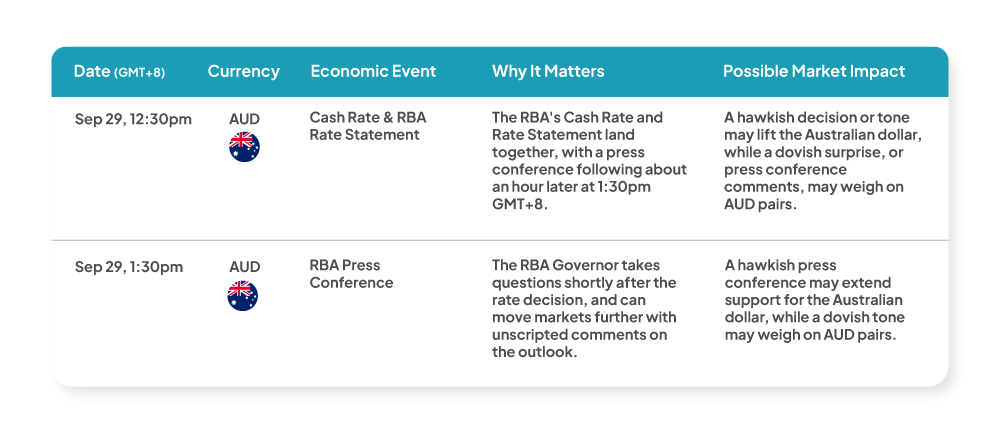
The Reserve Bank of Australia announces its Cash Rate decision and publishes the accompanying Rate Statement at 12:30pm GMT+8 on Tuesday, followed by a press conference at 1:30pm GMT+8. The Cash Rate was last set at 4.35%.
The Cash Rate is the benchmark interest rate for the Australian economy, and the Rate Statement explains the reasoning behind it. Because interest rates influence the return on holding a currency, markets tend to react less to the number itself than to the gap between the decision and what had already been priced in. The press conference matters for the same reason: its tone can shift expectations for the next meeting even when the rate is left unchanged.
A hawkish decision or statement may support the Australian dollar, while a dovish surprise may weigh on AUD pairs. Traders following forex market news may monitor AUD/USD and AUD/JPY, which typically respond first.
Sep 30 News: Australian CPI and US Core PCE and Final GDP
Australian CPI and Trimmed Mean CPI
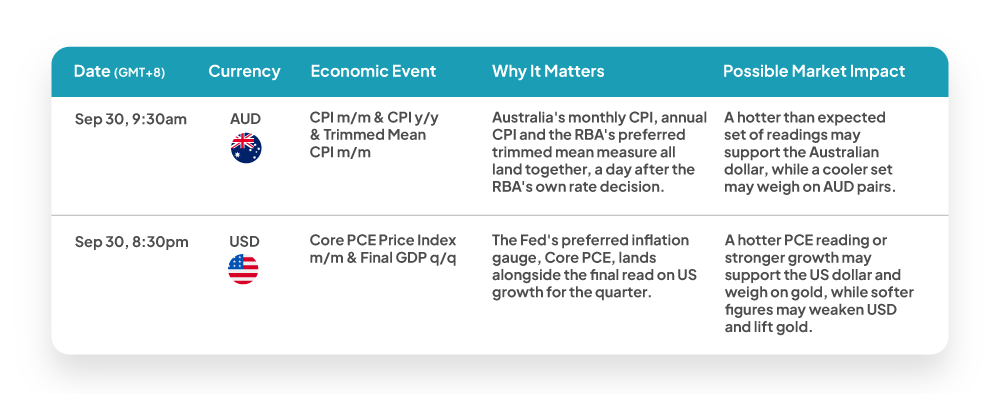
Australia's CPI m/m, CPI y/y and Trimmed Mean CPI m/m are released together at 9:30am GMT+8 on Wednesday, one day after the rate decision. The previous readings were 1.0%, 3.5% and 0.5% respectively. The Trimmed Mean strips out the most volatile price movements, so it is often treated as the better guide to the underlying inflation trend.
Because this inflation data lands the day after the rate decision, it may either reinforce or undercut the Rate Statement. Hotter inflation may support the Australian dollar, while a softer set of numbers may weigh on AUD/USD and EUR/AUD.
US Core PCE Price Index and Final GDP
Later the same day, at 8:30pm GMT+8, the United States publishes the Core PCE Price Index m/m alongside Final GDP q/q, last at 0.2% and 1.5%. Core PCE is the inflation measure the Federal Reserve watches most closely, which gives it more weight in interest rate expectations than the headline consumer price release.
Inflation data feeds into what traders expect central banks to do next, so a figure away from forecast may move the relevant currency quickly. A hotter PCE reading or stronger growth may support the US dollar, while softer figures may weigh on it. US Crude Oil Inventories follow at 10:30pm GMT+8 and may influence crude prices late in the session.
Oct 1 News: US ISM Manufacturing PMI
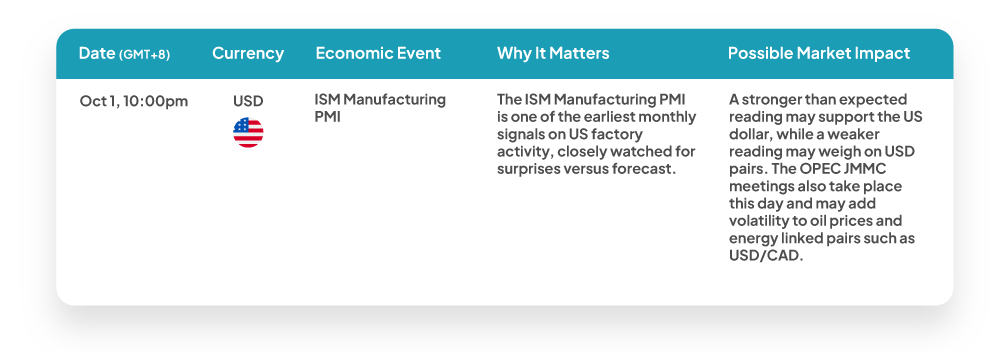
The ISM Manufacturing PMI is due at 10:00pm GMT+8 on Thursday, with the previous reading at 54.6. The survey asks purchasing managers at US factories about new orders, production, employment and prices, which makes it an early read on US factory activity before official data arrives.
The index is built around a midpoint of 50. A reading above 50 points to expansion and may support the US dollar, while a reading below 50 points to contraction and may weigh on it. Because the survey lands early in the month, it often gives a first indication of the month's economic direction.
The OPEC JMMC meetings also take place this day and may add market volatility to oil prices and energy linked pairs such as USD/CAD.
Oct 2 News: US Non Farm Payrolls
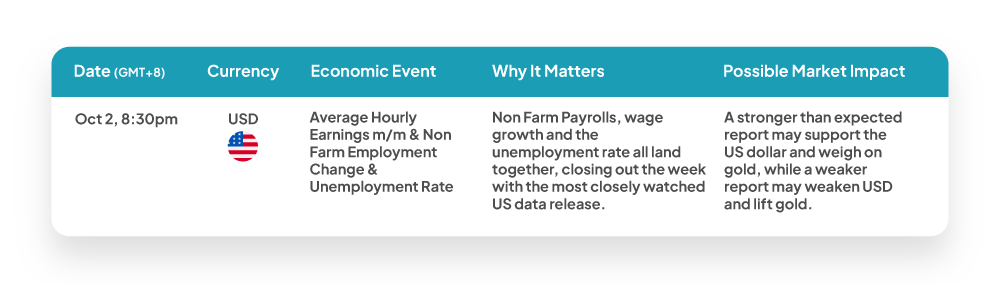
The week closes with US jobs data at 8:30pm GMT+8 on Friday. It covers Non Farm Employment Change, Average Hourly Earnings m/m and the Unemployment Rate, last at 162K, 0.3% and 4.1%.
Non Farm Payrolls counts the jobs added outside the farming sector in the previous month, and is the most closely watched jobs data on the economic calendar. It carries weight because employment and wage growth feed into both inflation and interest rate expectations. Since all three figures arrive at the same moment, a mixed set of numbers can produce a sharp initial move followed by a reversal.
A stronger than expected report may support the US dollar, while a weaker report may weigh on it and lift gold. Traders may monitor XAU/USD, EUR/USD and USD/JPY around the release, and may expect spreads to widen briefly at 8:30pm GMT+8.
Sources: ForexFactory: Economic Calendar for 28 September to 2 October 2026
Markets That May React to RBA Rate Decision and US Non Farm Payrolls
Each event in this weekly economic news update maps to a different set of instruments. The weekly market outlook groups them by where a reaction may show up first. This is educational context, not advice.
Forex
The Australian dollar carries the most event risk early in the week, with the rate decision and inflation data falling within 21 hours. AUD/USD and AUD/JPY may see the clearest reaction, and EUR/AUD and GBP/AUD may move as a second order effect.
The US dollar dominates from Wednesday onward. EUR/USD, USD/JPY and GBP/USD may respond to Core PCE, Final GDP, the ISM survey and Friday's jobs data, which is likely to set the tone into the following week.
Gold
Gold tends to respond to shifts in US interest rate expectations rather than to any single headline. A softer inflation print or weaker jobs data may lift XAU/USD, while stronger US data may pressure it. Both Wednesday and Friday are relevant here.
Oil and Indices
US Crude Oil Inventories on Wednesday at 10:30pm GMT+8 and the OPEC JMMC meetings on Thursday may both add market volatility to crude prices, which may affect energy linked pairs such as USD/CAD. Major US indices may react to Core PCE and to the jobs report, since both feed interest rate expectations.
Key Takeaway: RBA Rate Decision and US Non Farm Payrolls
This weekly market outlook builds toward Friday's US jobs data, with the RBA's rate decision and Australian CPI also in focus, plus US Core PCE, Final GDP and the ISM Manufacturing PMI along the way. Beginner traders may want to watch for wider spreads around these GMT+8 release times, especially on Friday, and may find it more manageable to observe how price settles after a release than to react to the first move. Follow Lirunex for each weekly economic news update and more forex market news.
Frequently Asked Questions About RBA Rate Decision and US Non Farm Payrolls
What economic events are important this week?
This weekly economic news update covers five scheduled releases. Between 28 September and 2 October 2026 the weekly market outlook carries the Reserve Bank of Australia Cash Rate decision on Tuesday at 12:30pm GMT+8, Australian CPI on Wednesday at 9:30am GMT+8, the US Core PCE Price Index and Final GDP on Wednesday at 8:30pm GMT+8, the ISM Manufacturing PMI on Thursday at 10:00pm GMT+8, and US Non Farm Payrolls on Friday at 8:30pm GMT+8.
Why does Non Farm Payrolls affect markets?
Non Farm Payrolls measures how many jobs the US economy added outside farming in the previous month. Employment and wage growth influence inflation, which influences what the Federal Reserve is expected to do with interest rates. Because all three figures arrive together, a result away from forecast may move the US dollar, gold and indices quickly.
How does CPI data influence forex?
The Consumer Price Index tracks how much the prices households pay have changed. Persistently higher inflation may lead a central bank to keep interest rates elevated, which can raise the return on holding that currency. A reading above expectations may therefore support the currency, while a softer reading may weigh on it. Core and trimmed mean measures are usually watched more closely than the headline figure.
Why do central bank decisions move currencies?
Interest rates shape the return available on holding a currency, so a decision that differs from what markets had priced in may prompt a repricing. The accompanying statement and press conference often matter as much as the rate itself, because the tone of the commentary shapes expectations for future meetings.
What should traders monitor before major economic releases?
Traders may check the release time in their own timezone, note the previous reading and the forecast so the size of any surprise is clear, and be aware that market volatility may increase and spreads may widen around the announcement. Reviewing position sizing before a release is more practical than adjusting during it.
What time are this week's economic releases in GMT+8?
The RBA Cash Rate decision is at 12:30pm on 29 September, with a press conference at 1:30pm. Australian CPI is at 9:30am on 30 September, and US Core PCE and Final GDP are at 8:30pm the same day. The ISM Manufacturing PMI is at 10:00pm on 1 October, and US Non Farm Payrolls is at 8:30pm on 2 October. Release times in this weekly economic news update should be rechecked against the live economic calendar before the week begins.
Ready for the Market's Next Move?
Discover the key economic events ahead and practice observing how markets react around important news releases with a free Lirunex demo account. Open a live account to experience real market conditions once you feel ready and understand the risks involved. Demo conditions and results may differ from live trading.
[ Open Free Demo Account ] [ Open Live Account ]
Risk Disclaimer: This article is for informational purposes only and is not investment advice. Demo results may differ from live trading. Forex and CFD trading involve significant risk of loss. Past performance is not indicative of future results. High impact events may cause sharp volatility, wider spreads and sudden price movements. Please understand the risks before trading.